Key Takeaways
- Ask a skilled **boat lift builder** to inspect the full system before you assume you need a total replacement. In a lot of Cape Coral cases, the frame, piles, dock, or decking can stay in place while cables, bunks, hydraulic parts, or cradle setup get fixed.
- Check for clear signs of a bad install early—uneven lifting, rubbing hulls, twisted beams, bad docking angles, or hard pier access. Those issues usually point to setup mistakes, not always a full rebuild.
- Know when repair is still smart and when it isn’t. A good **boat lift builder** should give you a blunt answer if corrosion, crash hits, cracked welds, bad codes, or poor pile spacing make repair a waste of time.
- Expect site conditions to drive the repair plan more than most owners think. Canal depth, bridge clearance, side setbacks, ship wake, pump-out traffic, storm surge, and saltwater exposure all change how a **marine** lift should be built or corrected.
- Ask direct questions about crane access, transport, replacement parts, motor sizing, paint protection, and custom fabrication before work starts. That’s where a seasoned **boat lift builder** shows whether they can fix a bad install without creating three new problems.
- Insist on seeing the repair plan before anyone touches your dock or lift. A careful **boat lift builder** should show you what stays, what gets replaced, what code issues need attention, and how the corrected setup will fit your boat—pontoon, tender, trailer-kept, or floating hull.
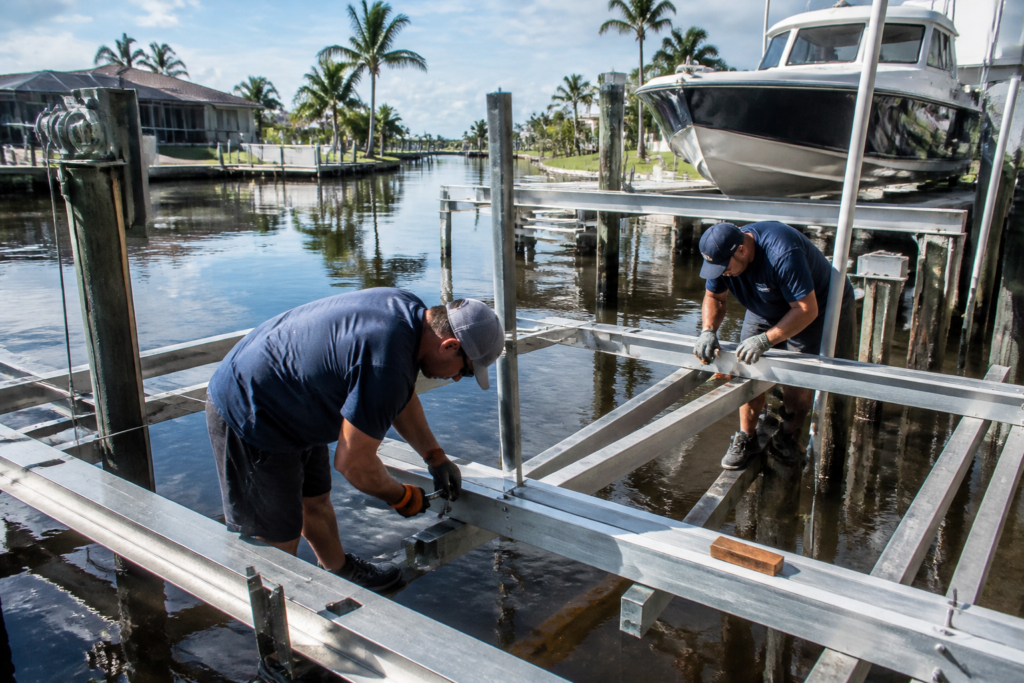
A bad boat lift install can turn a waterfront upgrade into a constant headache fast. In Cape Coral, a seasoned boat lift builder can often fix the real problem without tearing out every pile, beam, cable, and deck board—but only if the damage gets judged the right way from the start. That’s where a lot of owners get burned. They hear “replace it all” before anyone checks alignment, load paths, bunk setup, motor size, or whether the dock itself is throwing the lift out of square.
The honest answer is, some failed lifts are fixable and some aren’t. Bent cradle parts, worn cables, bad hydraulic pieces, poor decking tie-ins, even docking issues at the side of a pier can often be repaired. But corrosion, crash hits, bad codes work, or pile spacing that never fit the boat? Different story. Around Southwest Florida—where saltwater, storm surge, ship wake, pump-out traffic, and marine growth beat on everything year-round—a careful builder needs to know what can be saved, what shouldn’t be trusted, and where a smart repair stops being a smart idea.
Bad boat lift installs can often be repaired by a skilled boat lift builder
After a summer storm in Cape Coral, a homeowner hits the switch and the cradle racks to one side, cables groan, and the deck shakes. That’s the kind of bad install a seasoned boat lift builder sees all the time—and no, it doesn’t always mean a full rip-out.
In practice, a bad lift can often be saved if the pilings are sound, the dock framing still carries load, — the hydraulic or cable layout wasn’t butchered past repair. A crew that also works as marine dock contractors can spot if the trouble starts at the lift, the decking, or the dock itself.
Signs the dock, deck, or lift was built wrong from the start
- Cradle sits uneven—one side rises faster or the boat lists at the port side.
- Wrong bunk fit for a pontoon, tender, or V-hull ship.
- Loose through-bolts, split deck boards, or warped decking near the pier.
- Bad cable routing that rubs, jumps, or crash-hits the beam.
- Motor and pump mismatch that strains on every cycle.
What a boat lift builder checks before suggesting repair or full replacement
Not guesswork. A skilled crew checks pile spacing, beam alignment, welds, bunk placement, switch gear, fuel-clearance height, and local codes. They also look at corrosion, paint loss, trailer-style load balance, and whether a crane or barge can reach the side safely.
Sometimes the fix is simple—new cables, corrected bunks, fresh hardware. Sometimes the dock was built wrong from day one (that happens more than people think), and replacement makes more sense.
When a boat lift builder can save the frame, piles, and decking
Not every bad install needs a full tear-out. A seasoned boat lift builder can often keep the main frame, piles, and dock decking if the steel is still true, the pile spacing fits the boat, and the rot or rust hasn’t spread past a few hard-hit parts.
Fixing bent beams, worn cables, broken bunks, and bad hydraulic parts
In practice, repair makes sense when the trouble sits in working parts—not the whole structure. Bent beams, frayed cables, broken bunks, tired pumps, and bad hydraulic lines can often be swapped out without touching the pile cap or deck side access.
- Saveable parts: frame, piles, some decking
- Common replacements: cables, bunks, sheaves, motors, switches, hydraulic parts
- Red flags: cracked welds at load points, twisted cradle, pile movement
Correcting poor cradle setup for pontoon, tender, trailer-launched, and floating boats
A bad cradle setup beats up hulls fast—and that’s avoidable. A skilled boat lift builder can reset bunk spacing, raise one side, change guide placement, — correct lift points for a pontoon, tender, trailer-kept boat, or even a floating setup moved from dry storage or warehouse use.
Repairing dockside issues tied to docking, pier access, bridge clearance, and storage use
Dockside mistakes matter too. Poor docking angles, tight pier access, low bridge clearance, and clumsy storage layout can cause paint hits, crash damage, or hard boarding at port. Homeowners searching for boat lift builder near me usually need a repair crew that can fix both the lift and dock side details. Some jobs also call for floating dock contractors if the old docking plan never fit the boat in the first place.
Some bad installs are too far gone—and that needs a blunt answer
Can a bad lift install always be saved? No—and a seasoned boat lift builder should say that fast, not sell false hope. In Southwest Florida, some dock and marine lift failures look repairable from the deck side, but the real damage sits below the waterline.
Corrosion, crack damage, crash hits, and code problems that make repair a bad bet
Heavy corrosion on aluminum bunks, cracked welds, bent top beams, and crash hits from a trailer or tender can turn a repair into a gamble. If the hydraulic parts, cable paths, or piling brackets were installed out of line, the whole lift can rack under load—and that’s how a pontoon or fishing boat gets hurt. A good starting point is to call a boat lift builder in my area who knows local codes, dock permits, and safe load limits.
- Red flags: split welds, cable fray, rusted hardware, bad paint hiding metal loss
- Hard stop issues: failed piles, wrong beam span, missing bracing, poor docking clearance
When pile spacing, water depth, fuel exposure, or marine growth block a safe fix
Some sites fight the repair from day one. Tight pile spacing, shallow depth at low tide, fuel exposure from a nearby pump or ship service area, and thick marine growth can block crane access and safe transport of parts. Even common boat lift repair trends don’t change simple physics (or Florida saltwater). Sometimes the honest answer is full replacement. Short term sting. Long term sanity.
How a Cape Coral boat lift builder handles permits, codes, and site conditions
Cape Coral has more than 400 miles of canals—and that one fact changes almost every boat lift plan. A seasoned boat lift builder starts with city rules, water depth, — how the dock sits on the side of the lot, because a bad guess here can trigger inspection trouble fast.
Local codes, canal depth, side setbacks, and port-style access issues that affect the plan
Good boat lift builders don’t just build; they check setbacks, bridge clearance, deck height, and docking angles before a permit set goes in. In tighter canal lots, port-style access for a tender, trailer movement, or pontoon loading can limit beam width and lift placement (especially near a shared pier).
- Canal depth: affects bunk height, floating clearance, and hydraulic setup
- Side setbacks: can change piling location and deck or decking layout
- Access: room for pump-out traffic, fuel delivery, and safe transport to open water
Why saltwater, ship wake, pump-out traffic, and storm surge change how the lift should build
Saltwater is rough on cables, paint, motors, — hardware—that’s just the truth. A boat lift builder in Southwest Florida plans for ship wake hits, crash loads at the dock, storm surge, and heavy marine traffic, not just calm-day storage.
That’s why boat lifts often need stronger piles, better cradle spacing, and smarter motor placement—not warehouse-grade shortcuts.
What owners in Southwest Florida should expect during inspection, design, and install planning
Inspection comes first. Then design. Then permit submittal.
Simple idea. Harder to get right than it sounds.
- Site check for depth, soil, dock condition, and codes
- Lift sizing for hull, fuel load, gear, and clearance
- Plan review for install access, crane staging, and shipping limits
In practice, owners should expect straight answers, a clear build path, and no guessing—because that’s where bad installs start.
Choosing a boat lift builder who can fix mistakes without creating new ones
Most bad boat lift installs don’t need a full rip-out—that’s the myth. A skilled boat lift builder can often save the dock, cradle, beams, motor, or hydraulic setup if the real problem is poor sizing, bad cable routing, weak decking tie-ins, or sloppy docking alignment on one side.
Questions to ask about marine repair experience, crane access, transport, and replacement parts
Before hiring anyone, ask hard questions.
Has the company fixed crash damage, bent brackets, broken bunks, or bad pump wiring? Can they reach the pier with a crane or barge if bridge clearance blocks transport from the port? Homeowners searching for boat lift construction in my area should ask for repair photos—not just new build photos.
- Repair history: beam swaps, cable resets, motor replacement
- Access plan: crane, trailer, floating barge, or trailers
- Parts source: pulleys, switches, aluminum, hardware, bunk brackets
Why custom fabrication, paint protection, cable setup, and motor sizing make a real difference
Details matter. A real boat lift builder checks cable wrap, drum wear, sheave spacing, and motor size before calling for replacement. In practice, the difference between a clean repair and a second failure often comes down to custom marine fabrication, corrosion control, and proper paint or coating on steel parts—not guesswork.
What a careful boat lift builder should show you before work starts
A careful crew should show three things before work starts: 1) load rating vs. boat weight, fuel, tender, and gear, 2) a parts list, 3) a clear dock access plan. No mystery. No vague sketch.
Frequently Asked Questions
How much does it cost to build a boat lift?
A boat lift builder usually prices the job based on lift capacity, canal depth, piling layout, power supply, dock access, and permit work. In Cape Coral, a simple lift for a smaller center console is a very different job from a heavy-duty hydraulic setup for a large offshore boat. The honest answer is this: until someone inspects your dock, deck height, seawall, and water depth, any number is guesswork.
Who makes the best boat lift?
The best boat lift isn’t about a flashy brand name. It’s the lift that fits your boat’s real loaded weight, your dock layout, your wind exposure, and the local codes. In practice, a good boat lift builder will talk more about fit, beam width, bunk setup, motors, cables, and service access than sales talk.
What does a 10,000 pound boat lift cost?
A 10,000-pound lift can vary a lot based on cradle size, aluminum frame design, motor package, and whether the site needs extra pilings or dock changes. Add a canopy, solar accessories, remote controls, or new decking, and the scope moves fast. That’s why smart owners ask for a site visit—not a phone quote.
How much does a 30000 lb boat lift cost?
A 30,000-pound lift is a serious marine build.
You’re usually dealing with bigger beams, stronger pilings, heavier hardware, larger motors, and tighter engineering around bridge clearance, docking angles, and boat height at full rise. If you’re lifting that kind of weight, don’t shop by rough quote alone—shop by local experience and install quality.
How do I choose the right boat lift builder in Cape Coral?
Start with local work history.
A boat lift builder should know Cape Coral canals, Gulf access routes, permit rules, tide swing, salt exposure, and how storm hits affect dock and pier hardware. Ask to see recent installs, ask who handles permits, and ask who services the lift after it’s built.
Most people skip this part. They shouldn’t.
What type of boat lift is best for my boat?
That depends on the boat, not the brochure. A pontoon, tender, fishing boat, or larger ship-style offshore vessel all load a lift differently, and fuel, gear, pumps, and full water tanks add weight people forget about. Four-post lifts, elevator lifts, floating systems, and hydraulic models each have a place (and yes, the difference matters).
Do I need permits for a new boat lift or replacement lift?
Usually, yes. In Southwest Florida, permit work can involve city review, setback checks, dock rules, seawall conditions, and state or waterway review if your site is near a channel or port route. A seasoned boat lift builder should handle the paperwork and explain the codes in plain English.
Can a boat lift be added to an older dock?
Sometimes. But here’s what most people miss—an older dock may look fine on top while the piles, hardware, or side framing underneath are tired. Before any new lift goes in, the builder should inspect the dock, pier connection points, decking, electrical feed, and load path back to the structure.
How long does a boat lift installation take?
The install itself may move quickly once permits, materials, and barge access are lined up. The slower part is often engineering review, scheduling equipment, and getting the lift to your property if transport needs a crane, warehouse staging, or special trailers. That’s normal.
What maintenance does a boat lift need after installation?
Regular service keeps small issues from turning into broken cables, bad switches, or a stuck motor. I tell owners to clean salt buildup, watch cable wear, check bunks and paint on metal parts, and schedule inspections before peak boating season. Skip that, and the lift will tell you it needs help at the worst time.
And that’s where most mistakes happen.
A bad lift install doesn’t always mean a full tear-out. In plenty of cases, a skilled boat lift builder can save sound parts of the frame, piles, or dock and fix the real trouble—wrong cradle setup, tired cables, bent members, bad motor sizing, or hardware that never matched the boat in the first place. That kind of repair work takes more than guesswork. It takes a hard inspection, straight answers, and the judgment to say when a repair makes sense and when it doesn’t.
That blunt call matters in Southwest Florida, where saltwater, surge, wake, depth, and city rules can turn a small mistake into an expensive one. If corrosion has spread too far, pile spacing is wrong, or the lift was built in a way that won’t pass local standards, patching it usually creates a second problem—not a fix. A careful contractor should show the owner what can stay, what has to go, and why (before a wrench ever turns).
For Cape Coral owners who suspect their lift was built wrong, the next move is simple: schedule an on-site inspection with Coastal Marine Group, review the structure piece by piece, and get a clear repair-versus-replacement plan before another season on the water puts more stress on it.