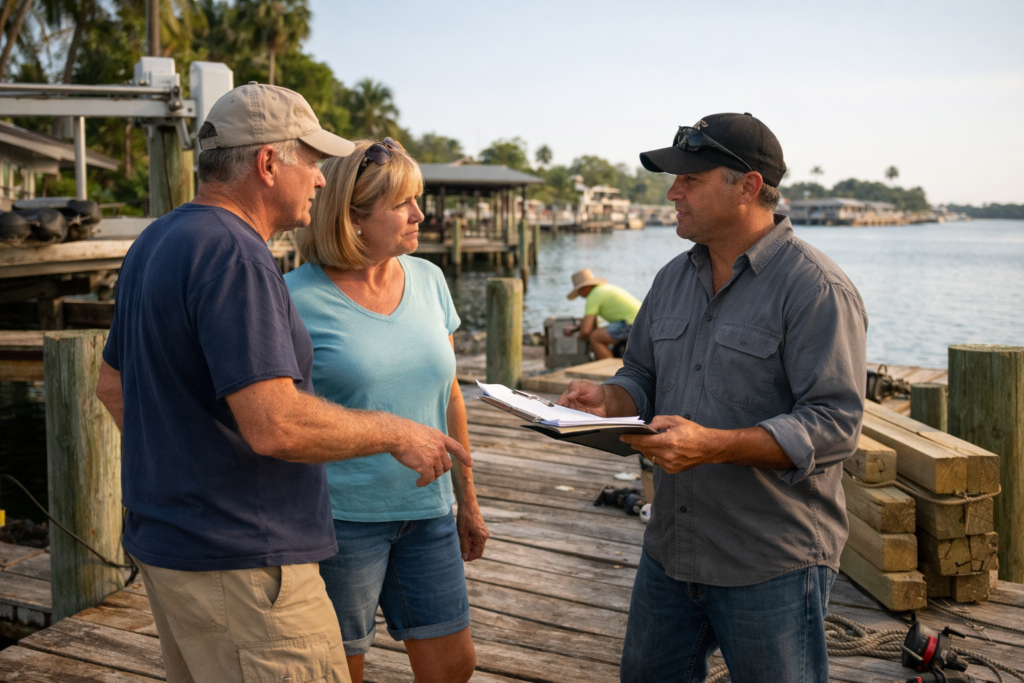
Key Takeaways
- Ask dock contractors for their Florida marine license details, insurance certificates, and recent permit history before you compare pricing. A qualified dock company should be able to show real construction and repair work on projects like yours.
- Press dock contractors on storm damage experience, not just new dock construction. Contractors who understand failed pilings, lift loads, hardware corrosion, and seawall movement usually catch safety problems earlier.
- Compare materials the hard way: ask why they recommend wood, composite, or aluminum dock systems for your shoreline, boat weight, and exposure. The right answer should include lifespan, repair needs, parts availability, and how those products hold up after hurricanes.
- Demand estimates that spell out scope, measurements, dock supplies, equipment access, demolition, haul-off, and change-order rules. Vague bids from dock contractors are where waterfront projects start drifting off budget.
- Use inspection photos and written findings to separate repair from replacement decisions. Good dock contractors don’t guess—they document deck framing, pile condition, hardware wear, and level issues so you can plan work in phases if needed.
- Shortlist dock contractors who can speak plainly about docks, lifts, seawalls, and long-term maintenance—not just sales. If a contractor can’t explain what will likely fail in the next two storm cycles, they’re not ready for a Florida waterfront job.
One bad hire can turn a dock repair into a five-figure redo after the next storm. That’s why Florida homeowners are screening dock contractors harder now—especially on older waterfront properties where loose hardware, tired pilings, and half-hidden lift damage don’t show up in a quick walkdown.
Across the state, recent hurricane seasons changed the standard. Cosmetic fixes don’t cut it anymore. A deck board swap might make a dock look better for 90 days, but it won’t solve racked framing, washed-out fill, corroded fasteners, or piles that have already started to fail below the waterline (and that’s where expensive surprises start).
In practice, the strongest contractor conversations happen before the first quote is accepted. Owners who ask sharper questions usually get clearer scopes, better documentation, and fewer ugly change orders once demolition starts. And in Florida—where permits, wind loads, wave action, boat traffic, and saltwater exposure all hit the same structure at once—that gap matters a lot.
Why Florida homeowners are vetting dock contractors more carefully after recent storm seasons
After the last major storm, one Cape Coral owner replaced a few deck boards and thought the dock was fine. Two months later, a lift beam twisted, the pilings shifted, and the insurance file got messy fast. That pattern keeps repeating, which is why dock contractors are being screened harder before any waterfront work starts.
How hurricane damage changed the standard for dock construction and repair
Storm seasons raised the bar for dock construction florida work. Owners now ask about uplift loads, pile embedment, hardware corrosion, and whether a dock builder cape coral fl documents hidden damage before repair starts. In practice, a qualified waterfront dock contractor should explain failure points—not just quote deck boards—and tie repair plans to permit, load, and access limits.
Why aging docks, lifts, and pilings need contractor input before cosmetic upgrades
Fresh decking can hide a bad structure. Before residential dock construction, custom dock construction, or a simple refit, owners should have a marine dock builder check piles, brackets, stringers, lift mounts, and electrical. That matters on dock construction cape coral jobs, on older canal dock construction, and anywhere a composite dock builder is covering frame movement that still needs correction.
What waterfront property owners risk when they hire the wrong dock company
Cheap bids carry a price.
Think about what that means for your situation.
- Missed permit issues: a dock permit contractor cape coral should know local setbacks and offer florida dock permit help.
- Wrong scope: owners needing dock repair and replacement often end up with patchwork instead.
- Poor fit: a floating dock contractor or dock installation florida crew may not be right for fixed structures.
Even a solid-looking quote can fail if the contractor can’t map replacement triggers, which is why some owners now start with a dock replacement contractor review before cosmetic work. Coastal Marine Group has noted the same shift after storm-response inspections.
Which dock contractors are actually qualified for Florida waterfront construction work
How can a property owner tell which dock contractors are truly qualified? The honest answer is simple: ask for proof, not promises. In Florida, a real dock construction florida firm should show marine licensing, active insurance, and a permit record tied to local waterfront work—not just general construction.
Questions to ask about licensing, marine construction experience, and local permit history
Start with direct questions. A qualified waterfront dock contractor or marine dock builder should explain:
- how many Florida marine projects were completed in the last 24 months
- whether they handle dock permit contractor cape coral filings, and florida dock permit help
- their history with dock construction cape coral, canal access, and shoreline setbacks
That matters. A contractor who knows dock builder cape coral fl standards — local systems will usually move faster through review.
How to verify insurance, subcontractors, and storm-damage repair credentials
Ask for certificates. Then verify workers’ comp, liability, and who is actually doing the piling, aluminum framing, or lift work. For storm claims, a contractor offering dock repair and replacement should document damage with dated photos, fasteners, parts, and repair scopes that insurance adjusters can follow.
Why do dock contractors with seawall, lift, and piling knowledge usually spot bigger problems earlier
Here’s what most people miss: good dock contractors don’t just look at decking. A firm experienced in custom dock construction, residential dock construction, dock installation florida, dock replacement contractor, composite dock builder, floating dock contractor, and canal dock construction will often catch failing pilings, washout near a seawall, or lift loads that don’t match the structure—before the repair bill doubles.
What to ask dock contractors about materials, dock systems, and long-term repair planning
Nearly 70% of premature dock failures in saltwater trace back to the wrong material mix or hidden hardware corrosion—not storm force alone. That’s why smart owners press dock contractors on construction details early, before a bid turns into a repair cycle three years later.
Wood, composite, and aluminum dock options: which construction choices hold up best in saltwater
In Florida, wood still works, but only with the right species, spacing, and fasteners. A seasoned waterfront dock contractor should explain where treated lumber makes sense, when composite decking cuts maintenance, and why aluminum systems help on lighter residential dock construction over canals.
Ask for direct comparisons on dock construction Florida jobs: heat retention, slip resistance, board replacement, and how each material performs after 5 to 10 salt seasons. In Cape Coral, canal dock construction often favors composite or aluminum, where sun, splash, and constant boat traffic wear surfaces fast.
Questions about pilings, hardware, levelers, parts, and other dock supplies that affect lifespan
Small parts decide lifespan. Ask dock contractors about piling wrap, stainless grades, galvanized versus coated hardware, bracket systems, levelers, and which dock supplies can still be sourced five years from now.
It’s a small distinction with a big impact.
- Pilings: timber, concrete, or wrapped repairs
- Hardware: 316 stainless in splash zones
- Systems: replaceable parts, not sealed assemblies
A qualified composite dock builder or marine dock builder should specify manufacturers, not just products.
How well contractors explain repair versus replacement without guessing
Good contractors don’t guess—they inspect connection points, ledger pullout, pile loss, and deck movement. Whether the owner needs dock replacement contractor advice, dock repair and replacement pricing, dock construction Cape Coral planning, or dock installation Florida guidance, the answer should include photos, measurements, and permit impacts. That’s especially true for custom dock construction, floating dock contractor work, Florida dock permit help, dock permit contractor cape coral coordination, and anyone comparing a dock builder cape coral fl for full replacement.
How Florida property owners should compare dock contractors on scope, pricing, and documentation
Bad paperwork sinks good projects.
That usually shows up after demolition starts, the tide shifts, or insurance asks for proof the owner doesn’t have. The fix is plain: compare dock contractors on scope, measurements, photos, permit responsibility, and record quality before any construction contract gets signed.
What a clear estimate should include for dock repair, rebuilds, and phased construction work
A solid estimate for dock construction florida work should spell out:
- Exact linear footage, deck height, pile count, hardware, and parts
- Repair versus replace language for dock repair and replacement decisions
- Phased pricing for a canal dock construction rebuild if budget or permit timing forces the works into stages
For a homeowner comparing a dock builder in Cape Coral, FL, with another waterfront dock contractor, vague allowances are a red flag. A qualified marine dock builder should separate residential dock construction from custom dock construction upgrades like aluminum framing, composite decking, or floating systems.
Questions about inspection photos, measurements, change orders, and insurance-friendly records
Ask for timestamped inspection photos, field measurements, and written change-order rules before work starts. Any dock permit contractor, Cape Coral, handling dock construction, Cape Coral jobs should also explain permit sequencing and offer Florida dock permit help in writing.
The difference shows up fast.
Why the cheapest bid from dock contractors often costs more within two storm cycles
Cheap bids usually hide missing pile wraps, downgraded supplies, or no allowance for soil movement. A dock replacement contractor, composite dock builder, or floating dock contractor that documents dock installation Florida standards will usually beat the low number within two storm seasons.
The smart way to choose dock contractors for residential and light commercial waterfront projects
Bad contractor selection gets expensive fast.
What search intent really means here: homeowners looking for a contractor they can trust, not just a name
- Start with scope fit. A waterfront dock contractor should show recent work in residential dock construction, light commercial repairs, lifts, and access equipment—not just generic marine construction or a list of products and supplies.
- Check local permit fluency. For dock construction in Cape Coral, ask who handles drawings, setbacks, and agency follow-up. A real dock permit contractor Cape Coral team can explain timing in plain English, and solid Florida dock permit help matters more than a polished sales pitch.
- Ask for material logic. A seasoned marine dock builder should compare aluminum, treated lumber, and composite based on salt exposure, wave action, and lift loads. That’s where a true composite dock builder sets itself apart from companies that push one system for every dock.
Signs a dock contractor is ready for complex Florida jobs involving docks, lifts, seawalls, and access equipment
Florida jobs stack problems. A contractor handling dock construction in Florida, dock installation in Florida, canal dock construction, and seawall tie-ins is usually better prepared for tricky grade changes and storm-damaged parts.
This is the part people underestimate.
And experience should be specific—a dock builder Cape Coral, FL crew that documents pile conditions, lift beam alignment, — washout risk is easier to trust during dock repair and replacement decisions.
A final contractor shortlisting checklist for safety, timeline, and rebuild decisions
- Confirm who handles inspections for custom dock construction and lift loads.
- Ask whether they’re a true dock replacement contractor or just a repair company.
- Verify if they build fixed and floating dock contractor systems.
- For narrow lots, ask for examples of staged dock contractors’ work with access limits—especially in canal homes.And that’s where most mistakes happen.
Frequently Asked Questions
What is the average cost to build a dock?
The average cost depends on the dock’s length and width, water depth, permitting, and the materials your dock contractors recommend. For a residential dock, owners often see rough starting ranges from about $15,000 to $40,000 for a modest build, while larger custom construction with lifts, aluminum framing, composite decking, or commercial-grade systems can climb well past that. The honest answer is this: price swings hard once repair issues, piling work, or electrical upgrades show up.
How much does a 30 ft dock cost?
A 30-ft dock typically costs $12,000 to $30,000, but that number can vary based on local labor, marine construction regulations, and site access. In southern markets like Tampa or Houston, storm standards and shoreline conditions can drive up costs. If a company quotes a suspiciously low number without discussing permits, pilings, hardware, or load requirements, that’s a red flag.
What do you call someone who builds docks?
Usually, they’re called dock contractors, marine contractors, or dock builders. If the job includes seawalls, lifts, commercial equipment, or floating dock systems, the company may also describe itself as a marine construction contractor. Titles vary. Experience matters more.
How much does a 200-foot dock cost?
A 200-foot dock is a major project, not a small backyard add-on, and costs can run from $80,000 to $250,000 or more. Length drives material and labor costs, but soil conditions, wave exposure, permits, utility runs, and whether the structure is aluminum, timber, or commercial-grade all matter just as much. Long docks also need better planning for maintenance and future repair parts.
Simple idea. Harder to get right than it sounds.
How do dock contractors estimate a repair versus a full replacement?
Good dock contractors start with the bones: pilings, framing, connectors, deck attachment points, and any movement at the shoreline transition. If 25% to 35% of the structural members are failing—or if storm damage has twisted the frame out of level—replacement often makes more financial sense than patchwork repair. Cosmetic boards are cheap. Structural failure isn’t.
How long should a dock last?
A well-built dock can last 20 to 40 years, and sometimes longer, if the original construction matched the site and the owner kept up with inspections. Aluminum systems usually hold up well in marine environments, while wood docks need closer attention to fasteners, rot, and marine growth. In practice, the first 10 years are about maintenance; after that, condition trends matter more than age alone.
What should property owners ask dock contractors before signing a contract?
Ask who handles permits, what materials are being installed, what parts are excluded, and whether the bid includes demolition, haul-off, and hardware replacement. Also, ask how the company documents damage for insurance and whether they’ve done similar dock construction in your waterway—not just somewhere in Michigan, Minnesota, Maine, Dallas, or the Midwest, but in conditions like yours. A clean quote should leave very little to guesswork.
Are aluminum docks better than wood docks?
For a lot of waterfront owners, yes—especially where salt, heat, and repeated storm exposure are part of life. Aluminum dock systems are lighter, usually easier to service, and often simpler to reconfigure with levelers, accessories, and replacement products from established manufacturers. But wood still works in the right setting if the design is sound and the owner is willing to accept more upkeep.
Do dock contractors handle permits and inspections?
Some do, some don’t, and that split matters more than people think. A marine construction company that handles permits, drawings, and inspection coordination usually saves weeks of confusion and helps avoid expensive corrections later. Before hiring anyone, ask that question plainly.
How do owners compare dock contractors without getting lost in sales talk?
Strip it down to five things: structural scope, materials, timeline, exclusions, and storm-readiness. Then compare photos of similar works, not just pretty finished docks, and ask what repair history those designs have had after real weather. The best dock contractors don’t hide behind brochures—they’ll explain why one design works better, where it can fail, and what it will cost to maintain.
Choosing between dock contractors in Florida isn’t just about price or how fast a crew can get on the calendar. After the last few storm seasons, the real test is whether a contractor can spot structural trouble early, explain permit and material decisions plainly, and document the job in a way that protects the property owner later — during repairs, insurance review, or the next major weather event. That’s where weak bids usually fall apart.
Better questions tend to reveal a better contractor. A clear answer on licensing, marine experience, piling condition, lift systems, hardware, and phased repair planning says more than a polished sales pitch ever will. And if a contractor can’t show photos, measurements, scope details, or change-order process up front, that’s a warning sign, not a minor gap.
Before signing anything, property owners should narrow the list to three qualified contractors, ask each one the same job-specific questions, and request written estimates with inspection photos and repair-versus-replacement notes. Then compare the details side by side. That’s how smart waterfront projects start — and how expensive mistakes get stopped before the first board comes off.
Coastal Marine Group
| 📍 | 424 SE 47th Terrace A, Cape Coral, FL 33904 |
| 📞 | (239) 372-4586 |
| 🌐 | https://coastalmarinegroup.net/ |