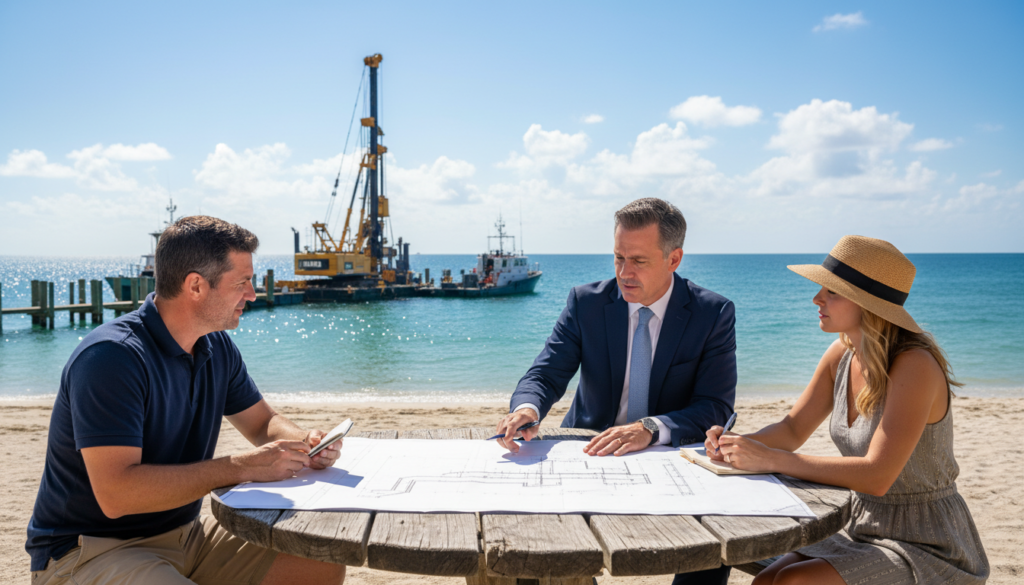
Over 60% of waterfront repairs trace back to poor initial work. That single stat shows why your first hire matters. You want a partner who shields your property and your wallet.
Start with verification. Focus on licensed, insured professionals who know local tides, soils, and permit rules. Proper credentials cut risk and speed approvals.
Look for teams with specialized gear and clear portfolios. Ask about past docks, seawalls, or bulkheads and request references. A skilled team will explain coastal limits and maintenance needs in plain language.
Key Takeaways
- Verify licenses and insurance before any agreement.
- Check experience with local waterfront projects and permits.
- Confirm the crew has proper equipment for harsh conditions.
- Request references and review past work photos.
- Prioritize clear contracts that spell out warranties and timelines.
Understanding the Importance of Professional Marine Construction
Salt, tides, and shifting soils make shoreline projects a unique engineering challenge. You need teams that read both blueprints and local water patterns.
Most problems reported by the Contractors State License Board (CSLB) could be avoided when homeowners know their rights and take responsibility for a project. That responsibility starts with asking questions and confirming credentials.
Professional marine construction differs from standard construction in material choice, permitting, and staging. General firms may miss erosion control, pile sizing, or tidal impact that affect long-term performance.
- Specialized knowledge protects assets against salt, currents, and seasonal storms.
- Qualified contractors follow permits and safety codes that keep your structure legal and safe.
- Businesses in Florida often need expert work for docks, boardwalk repairs, or commercial lifts.
Proper planning and professional execution are the foundation of any successful waterfront project. When you insist on expertise, you reduce risk and extend service life.
How to Choose a Marine Construction Contractor Near Me
Start by narrowing options to local companies with solid track records and clear project histories. Look for firms that list past waterfront work and provide photos or references you can check.
Verify credentials early. Ask for license numbers and call the CSLB at (800) 321-2752 or use their online database. That step saves time and reduces risk.
Interview each team and request detailed explanations of methods, timelines, and materials. A reputable contractor will show documentation and explain how their construction choices protect your shoreline.
- Shortlist local companies with proven results.
- Request clear records of past projects and permits.
- Confirm licensing via CSLB and check references.
| Check | What to Ask | Why It Matters |
|---|---|---|
| License | Get number; verify with CSLB | Protects you from unqualified contractors |
| Experience | See similar waterfront projects | Shows practical knowledge of local conditions |
| References | Call past clients; visit sites if possible | Confirms quality and reliability |
Verifying State Licensing and Credentials
Always verify the state license number shown on ads or contracts before moving forward. That small check cuts risk and gives you documented proof of legal standing.
Checking License Status
Every advertisement, business card, and contract must display the contractor’s state license number. Use that number and call (800) 321-2752 or search the CSLB database online for current status.
Verifying Salesperson Registration
If the firm uses sales staff, those individuals must be registered as Home Improvement Salespersons. Ask for registration details and confirm them before any agreement.
- Ask to see the pocket license and a photo I.D. for the person who will perform the work.
- Never assume a listed number is valid — always check the CSLB record for full information.
- Collect documentation early. This protects you and shows the sure contractor follows state construction rules.
Checking for Proper Insurance Coverage
Your project starts safer when the business handling it shows clear proof of insurance. Ask for a Certificate of Insurance or the carrier name and verify that the policy lists your job and property.
In California, employers with employees must carry workers’ compensation. If workers are hurt and coverage is missing, you risk financial liability.
Commercial general liability is not always required by law, but it protects against damage during work. Insist on seeing policy limits and dates.
- A responsible contractor provides their insurer’s name and a certificate that you can confirm.
- Look up the license number on the CSLB to find the address of record and confirm the business location.
- Keep copies of all insurance information. This protects you and helps resolve disputes if they arise.
| Coverage | Why it matters | What to check |
|---|---|---|
| Workers’ compensation | Protects you from payroll liability | Policy active; covers employees |
| General liability | Covers damage to your property | Limits, exclusions, effective dates |
| Certificate of Insurance | Proof you can verify with carrier | Carrier name and contact number |
Evaluating Areas of Specialization
Complex coastal projects require teams trained in tidal behavior and saltwater durability. You want firms that match the job, not general builders applying land methods to wet sites.
Distinguishing Marine from General Construction
Specialized projects include jetties, boat lifts, seawalls, bulkheads, and floating docks. Each demands different methods, heavy equipment, and corrosion‑resistant materials.
A qualified marine construction company understands pile sizing, sheet piling, and anchoring systems. They also keep permits and environmental rules in mind during planning.
Many general construction companies lack experience with floating dock installation or steel sheet piling. Check past projects and ask about materials meant for salt air and current exposure.
- Confirm the company lists similar projects and photos.
- Ask which materials they install and why those resist corrosion.
- Look for firms that offer design, permits, and specialized services in one package.
| Feature | General Construction | Specialized Marine Firms |
|---|---|---|
| Common projects | Houses, decks, land grading | Seawall, dock, boat lift, jetty |
| Key materials | Standard timber, concrete mixes | Galvanized steel, treated pilings, marine-grade concrete |
| Permitting & engineering | Basic site permits | Environmental permits, coastal engineering |
| Equipment | Basic earthmoving | Barges, pile drivers, crane barges |
Assessing Financial Responsibility and Business Stability
Financial stability often predicts whether a firm can keep crews, equipment, and schedules intact.
Ask local customers, material suppliers, and subcontractors about payment habits and job performance. Those who deal with the firm daily will tell you if bills get paid and crews stay on site.
Contact banks or credit references for confirmation of creditworthiness. This step helps you judge whether the contractor can fund materials and payroll without delays.
Check trade associations and the Better Business Bureau for long-term records. Look for patterns of complaints or repeat praise.
Use this checklist when vetting a partner:
- Vendor feedback on payment timeliness.
- Subcontractor reports on scheduling and change orders.
- Financial references from banks or suppliers.
| Source | What to Ask | Red Flag |
|---|---|---|
| Material supplier | History of on-time payments | Short payment windows or paused accounts |
| Subcontractor | Frequency of late starts or missed crews | Unpaid invoices or stopped work |
| Financial institution | Credit lines and lending history | Repeated loan defaults |
| Trade groups / BBB | Complaints and resolutions | Unresolved complaints over years |
Financial responsibility is a key indicator that the team can manage the complexities of a large-scale construction project without unexpected shutdowns. For more on specific repair trends and lift work, see this recent industry post.
Requesting and Comparing Detailed Bids
Ask each bidder for a written, line‑item estimate so you can compare apples with apples. Get at least three written bids for your project. This gives you a clear picture of price, materials, and schedule.
Comparing Identical Scopes
Make sure every proposal uses the same plans and specifications. If one bid omits a task, that will show up as a low number but a costly change order later.
- Match scopes line by line so materials and allowances are identical.
- Ask bidders to confirm exclusions in writing.
- Use the same timeline when evaluating price and scheduling risks.
Avoiding Abnormally Low Bids
Beware any offer far below the rest. An abnormally low price often signals skipped work, cheaper materials, or estimation errors.
Accepting the lowest bid can lead to disputes and delays if the contractor must cut corners to meet that figure.
| What to Check | Possible Red Flag | Action |
|---|---|---|
| Material specs | Vague or missing | Ask for manufacturer and grade |
| Labor allowances | Unusually low hours | Request crew lists and schedule |
| Contingencies | None listed | Include written allowances |
Final tip: prioritize fair price over the lowest cost. That helps protect long‑term quality and reduces the chance of surprises during work.
Conducting In-Person Consultations
Meeting on site lets you see equipment, past work, and how the team treats safety. Schedule a conversation with each marine construction company on your list. Use that time to gauge fit and ask clear questions.
Ask about experience, fees, and daily work habits. Request examples of similar projects and which materials they prefer. A reputable team will explain choices and timelines plainly.
“An in‑person meeting reveals more about work habits and professionalism than any brochure.”
Take this step seriously. Meeting face‑to‑face is a simple way to test communication, trust, and project management. You will also learn whether their services match your expectations.
- Confirm past jobs and ask for references you can call.
- Ask about material sources and corrosion protection for marine work.
- Discuss fee structure and expected time on site for each phase.
Final step: compare impressions and pick the company that shows clear process, honest answers, and respect for your timetable.
Reviewing Past Projects and References
Your best test is real results: review finished project photos and talk with past customers.
Ask the company for a gallery that shows similar projects. Walk through images and note methods, materials, and site conditions. A clear gallery reveals the team’s real skills.
Request names you can call. Speak with owners about communication, schedule reliability, and overall quality. Friends and family who had similar work done make excellent reference sources.
Give special weight to firms with long records. For example, Yelton Construction has been serving customers for more than thirty years and shows many successful projects.
- Check local building departments or trade associations for complaints or praise.
- Confirm recent work was completed on time and within scope.
- Use references as a final verification step before signing.
| What to Check | Why it Matters | Example |
|---|---|---|
| Gallery of past work | Shows real methods and finishes | Seawall, dock, lift photos |
| Reference calls | Reveals communication and management | Past customers’ feedback |
| Local records | Confirms business reputation | Permits, trade group notes |
Successful projects are the clearest indicator of consistent quality. This step reduces risk and helps you pick a trusted partner for your shoreline needs.
Understanding the Role of Bonds in Your Project
Bonds act as a formal safety net for project owners when work falls short of code or contract.
In California, licensed professionals must carry a contractor license bond that protects owners against substandard work and code violations.
Types of Contractor Bonds
Not all bonds perform the same role. Some exist for licensing, some for performance, and some cover payment for subcontractors and suppliers.
- Contractor license bonds — mandatory in many states for license protection.
- Contract bonds — guarantee that the scope and timeline will be met.
- Performance and payment bonds — often required by lenders for large construction and marine projects.
| Bond Type | Primary Purpose | When Lenders Require It |
|---|---|---|
| License bond | Protects owner versus code failures | For licensed building work |
| Performance bond | Ensures contractual completion | Large commercial projects |
| Payment bond | Covers unpaid subs and suppliers | When multiple contractors are involved |
Remember: bonds do not guarantee skill or financial strength. They provide remedies when work fails. For detailed information, consult the CSLB’s Guide to Contractor License Bonds.
Identifying Red Flags During the Selection Process
Watch for firms that operate from temporary addresses or list only a cellphone; those setups make follow-up service hard when issues arise.
Avoid high-pressure sales tactics. If you feel rushed into large upfront payments before work begins, step back and get written terms. Trust is earned, not forced.
Insist on proof. If someone refuses to show valid insurance or a license number, remove them from your shortlist immediately. That documentation protects you if problems occur.
Also watch for vague estimates or evasive answers about damage control. Clear, line‑item proposals explain who fixes accidental damage and how claims get handled.
- Permanent address and reachable office matter.
- No large deposit before contract and permits are signed.
- Written proof of insurance and licensure is mandatory.
| Warning Sign | Why It Matters | Action |
|---|---|---|
| No business address | Hard to contact after completion | Remove from consideration |
| High upfront payments | Raises risk of unfinished work | Require escrow or phased payments |
| No insurance/license shown | Liability and legal exposure | Ask for carrier contact and verify |
| Vague estimate | Leads to surprise costs | Request detailed, itemized bid |
“Identifying these warning signs early protects you from legal and financial disputes later.”
Confirming Equipment and Operational Capabilities
Owned vessels and certified barge gear give you real control over scheduling and safety.
Before signing a contract, verify that the company owns or has ready access to barges, cranes, and workboats. This matters whether your project is a seawall repair, a dock replacement, or a lift installation.
Specialized Equipment
Ask for a list of equipment and the number of vessels the business operates. Knowing their fleet helps you judge response time for urgent site work.
Owned gear reduces rental delays and shows investment in long-term projects. It also signals readiness for complex structures and timely completion.
Fleet Maintenance
Proper maintenance keeps crews and customers safe. Request maintenance logs, recent inspections, and proof that employees trained for vessel operations are on staff.
- Confirm barge and crane certifications.
- Check vessel maintenance records and crew readiness.
- Verify that the team can mobilize for your job with minimal downtime.
Tip: firms like American Marine Corporation that maintain their fleet often finish projects faster and with fewer surprises.
Prioritizing Quality Over the Lowest Price
Paying less upfront often costs more when long-term durability matters.
The bottom line for any marine construction project is the quality of the finished product, not the lowest price on the bid sheet.
Low-bidding firms may skip specifications, use lower-grade materials, or rush work to protect margins. That approach often leads to early failures and expensive repairs shortly after completion.
Invest in proven workmanship and proper materials. Your dock, seawall, or boat lift should last decades, not months.
- Prioritize end-product durability over rock‑bottom price.
- Confirm materials and warranties in writing before work starts.
- Pick professionals with documented, completed projects you can inspect.
“True value shows in durability, safety, and on-time completion — not just the number on a bid.”
| Decision Point | Low Price Result | Quality-Focused Result |
|---|---|---|
| Material choice | Budget timber or generic mixes | Marine-grade piles and corrosion-resistant mixes |
| Workmanship | Rushed crews, missed details | Skilled crews, documented inspections |
| Project longevity | Early repairs and higher lifecycle cost | Long service life and lower maintenance spend |
Conclusion
Follow a simple checklist, and you will reduce risk and make better choices for your waterfront project.
Verify licenses and insurance, confirm specialized experience, and review past projects. Prioritize quality and professional integrity over the lowest bid. That protects the structure and your long-term costs.
Meet teams in person, call references, and check equipment and bonds. Look for stable business practices and clear documentation before signing any agreement.
Take these steps and you’ll be far more likely to finish on time, on budget, and with work that lasts.
FAQ
What credentials should you expect from local marine builders?
Look for a valid state contractor license, proof of insurer coverage including general liability and workers’ compensation, and any specialty certifications for seawalls, docks, or pile driving. Ask for license numbers and verify them on your state contractor board’s website.
How can you tell if a company focuses on waterfront projects or general work?
Review the firm’s portfolio and project list. Waterfront specialists will show completed seawalls, boat lifts, floating docks, bulkheads, and marina work. If most projects are homes or commercial buildings, the firm likely leans toward general construction.
What questions should you ask during an on-site consultation?
Ask about expected timelines, materials, staging, marine permits, sediment control, and access for heavy equipment. Request a site-specific plan and clarify who will handle permit submissions and inspections.
Why is insurance so important for waterfront jobs?
Waterfront jobs involve heavy gear, water hazards, and environmental risk. Proper insurance protects your property and limits your liability if an accident or spill occurs. Confirm policy limits and get certificates naming you as an interested party when needed.
What makes a bid reliable versus suspiciously low?
Reliable bids include labor, materials, permit fees, contingencies for tides and weather, and clear scope definitions. Abnormally low bids often cut corners on materials, skip permits, or hide change-order risk. Compare identical scopes to spot red flags.
How do you verify past performance and references?
Contact recent customers and visit completed sites if possible. Ask about schedule adherence, cleanup, communication, and how the crew handled unexpected issues like subsurface obstructions or storm delays.
What bonds should you expect for larger projects?
For bigger jobs, request performance and payment bonds. A performance bond guarantees completion per contract terms; a payment bond protects your subcontractors and suppliers. These reduce your financial risk if the firm defaults.
How important is the contractor’s equipment and fleet condition?
Very important. Qualified firms maintain barges, cranes, pile drivers, and trenching gear to handle marine loads safely. Ask about fleet age, maintenance schedules, and backup equipment for critical tasks.
What environmental permits and protections are typically needed?
Expect permits from state coastal agencies, the Army Corps of Engineers, and local authorities for work below the high-water mark. Contractors should follow erosion control, turbidity containment, and spill-prevention plans to protect water quality.
How do you assess a company’s financial stability?
Ask for references from suppliers, evidence of bonding capacity, and a history of completed projects. Firms with steady cash flow and local bank relationships are less likely to stall your job due to financial strain.
What are common red flags during selection?
Red flags include lack of licensing, vague or verbal-only bids, no proof of insurance, poor communication, high staff turnover, and unwillingness to provide references or show recent work on the water.
How should you compare multiple estimates effectively?
Create a side-by-side list with identical scopes: materials, timetables, permit responsibilities, cleanup, and warranties. Score each line item and favor firms that balance price, quality of materials, and clear timelines over the lowest bid.
What warranty and maintenance terms should you expect?
Expect a workmanship warranty of at least one year and material warranties from manufacturers for decks, pilings, or lifts. Clarify maintenance recommendations for finish coatings, fasteners, and flotation devices to preserve longevity.
How long will typical waterfront structures take to complete?
Timelines vary by scale: small docks might finish in days, seawalls and bulkheads can take weeks, and complex marina builds months. Weather, tides, permitting, and material lead times commonly affect schedules.
Can contractors handle permitting and inspections for you?
Yes. Experienced firms often coordinate permits, environmental reviews, and inspections. Confirm who files applications, pays permit fees, and attends inspection meetings so responsibilities are clear up front.
What should you include in the contract before work starts?
Include detailed scope, materials list, schedule, payment milestones, change-order process, insurance and bond details, warranty terms, and dispute resolution. Clear contracts prevent misunderstandings during construction.
How do boat lifts and floating dock installations differ from fixed structures?
Boat lifts and floating docks require specialized hardware, anchoring systems, and buoyancy calculations. Fixed structures like pile-supported docks and seawalls demand heavy equipment, pile driving, and different permitting. Choose a firm experienced with your specific structure type.
What ongoing communication should you expect during the job?
Expect regular updates on progress, upcoming inspections, weather delays, and any unforeseen conditions. A dedicated project lead or superintendent provides clear points of contact and improves on-site coordination.