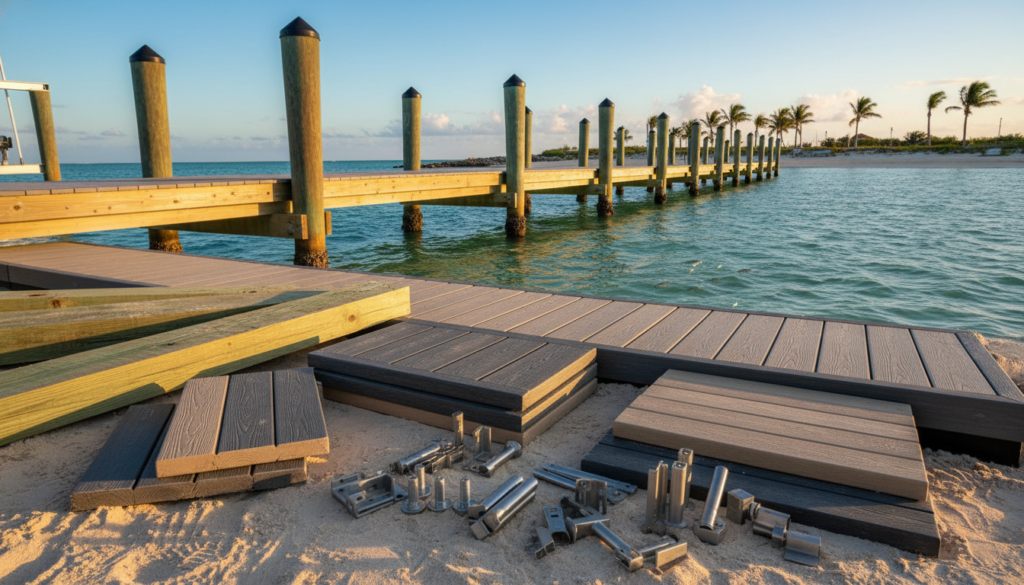
You live by the water to relax, not to chase constant upkeep. Choosing the right decking and support material affects safety, appearance, and long-term cost.
Traditional wood often needs frequent staining, sealing, and repairs. That upkeep can strip the joy from your boat days and weekend projects.
Modern options like composite decking and PVC decking offer far better durability and lower maintenance, so your platform stays safer and looks nicer over time.
Whether you’re building new or upgrading, the choice of material shapes your waterfront life. This guide helps you weigh options so your dock lasts and your time on the water stays about memories, not fixes.
Key Takeaways
- High-performance decking can cut repair frequency and long-term upkeep.
- Wood needs regular staining and sealing to stay usable near salt water.
- Composite decking and PVC decking offer improved durability and appearance.
- Your material choice affects safety, look, and maintenance costs.
- Upgrading now can protect your waterfront investment over time.
Understanding the Unique Challenges of Saltwater Environments
Salt air and bright reflections make waterfront life special, but they also speed wear on every part of your pier. You need to understand how the local environment attacks common choices so you can pick smarter decking and framing.
The Corrosive Nature of Salt Spray
Salt spray accelerates corrosion and eats at metal fasteners, brackets, and untreated hardware. Even pressure-treated posts can show failure faster near the shore.
Moisture Absorption and Structural Decay
Constant moisture lets wood absorb water, warp, and rot. That means frequent sealing, sanding, and upkeep if you stick with traditional wood decking.
- High foot traffic and standing water increase wear and demand low-maintenance options.
- Sun and reflected light fade and weaken some boards over time.
- Coastal humidity and spray often act together to speed corrosion and decay.
Understanding these stressors is the first step to choosing decking, fasteners, and framing that last through heavy use, boat traffic, and exposure.
Evaluating the Best Materials for Dock Construction in Saltwater Environments
Picking the right decking and framing changes how much time you spend on upkeep and repairs.
The performance of advanced PVC is a major reason many waterfront owners switch. TimberTech Advanced PVC is 100% inorganic and contains no wood flour, so it resists rot and decay near water. MAX boards at 1.5 inches add strength where heavy use and boat traffic demand it.
The performance of advanced PVC
PVC decking stays dimensionally stable and needs far less staining and sealing than wood. That lowers routine maintenance and keeps the look consistent over time.
Comparing composite decking options
Trex composite decking is marine grade and holds up even if exposed to sand and spray. Composites blend appearance and low upkeep, though density and fade resistance vary by brand.
The role of aluminum in marine settings
Aluminum gives excellent rust resistance and long-term durability for frames and gangways. It’s lighter and often easier to install, but can be noisier underfoot than wood-style decking.
- TimberTech PVC: inorganic, rot-resistant.
- MAX boards: thicker for heavy-use areas.
- Trex: marine-grade composite resistant to immersion.
- Aluminum: rust-resistant framing with strong lifespan.
Balance appearance, maintenance, and durability so your waterfront stays a low maintenance oasis you actually use.
Why Your Choice of Framing and Hardware Matters
Your frame and fasteners are the unsung heroes of any dock. Aluminum framing offers outstanding rust resistance and gives you a lighter, stable base that won’t warp or split over time. That stability protects decking and reduces long-term maintenance.
Use stainless steel or hot-dip galvanized hardware to stop corrosion before it starts. When screws, bolts, and brackets fail, even the best decking will loosen and risk safety.
Wood framing still gets used, but it often succumbs to moisture and rot faster than metal systems. That means more repairs and faster replacement cycles if you rely only on timber.
“Investing in an engineered aluminum system gives a stable base that will not warp or split.”
- Aluminum frames resist rust far better than steel.
- Marine-grade fasteners prevent corrosion and loose boards.
- Choose components rated for water and salt exposure to protect your boat dock.
Make the right choice of framing and hardware and your decking, whether PVC or composite, will perform as intended and keep your waterfront safer and easier to enjoy.
Prioritizing Safety and Comfort on Your Waterfront Deck
Keep your shoreline area usable by choosing decking that sheds water and resists heat buildup. A few smart choices cut slips and lower routine maintenance while improving the look of your dock.
Enhancing Traction for Wet Conditions
Traction matters most when surfaces are wet. Textured PVC grain and slip-resistant finishes give you grip underfoot and reduce fall risk near the water.
ShoreMaster’s Vertex™ decking features a slip-resistant surface engineered to stay safe even in wet conditions. Glacier™ flow-through decking helps water drain away fast, cutting standing water that causes slips.
Comfort under the sun is also important. Choose composite or PVC options with heat-reflective properties so the surface stays cooler for bare feet and pets.
- Use contrasting colors on edges to improve visibility at dusk.
- Add railings and non-skid strips in high traffic areas.
- Prefer flow-through or grooved profiles to manage moisture and exposure.
Even durable options like concrete or plastic need slip resistance. Pick surfaces that balance safety, durability, and low upkeep so your dock stays a welcoming space year-round.
Conclusion: Investing in a Long-Lasting Waterfront Oasis
Smart choices today save you time and money on upkeep tomorrow. ,
ShoreMaster has led marine systems for over 50 years, proving that quality frames and decking pay off over time. Choose rot-resistant PVC decking and aluminum framing to cut staining, sealing, and cleaning cycles that plague traditional wood.
That choice improves safety, keeps the look consistent, and reduces ongoing maintenance. Treat your dock as a long-term investment in comfort and curb appeal.
Need site-specific help? See guidance on planning and local services for new dock builds in Florida to match products and layout to your water, bottom, and use.